<?xml version="1.0" encoding="utf-8"?><feed xmlns="http://www.w3.org/2005/Atom" ><generator uri="https://jekyllrb.com/" version="4.4.1">Jekyll</generator><link href="https://vyb3r.ca/feed.xml" rel="self" type="application/atom+xml" /><link href="https://vyb3r.ca/" rel="alternate" type="text/html" /><updated>2026-07-25T05:02:18+00:00</updated><id>https://vyb3r.ca/feed.xml</id><title type="html">Seraf Dos Santos - Software Engineer / Artist</title><subtitle>This is my personal blog where I share my thoughts on software engineering, art, and other topics that interest me. I also use this blog to document my projects and share my opinions on various subjects.</subtitle><entry><title type="html">I Once Dreamt of a World of DAOs</title><link href="https://vyb3r.ca/shared/opinion/2026/07/24/i-once-dreamt-of-a-world-of-daos.html" rel="alternate" type="text/html" title="I Once Dreamt of a World of DAOs" /><published>2026-07-24T12:00:00+00:00</published><updated>2026-07-24T12:00:00+00:00</updated><id>https://vyb3r.ca/shared/opinion/2026/07/24/i-once-dreamt-of-a-world-of-daos</id><content type="html" xml:base="https://vyb3r.ca/shared/opinion/2026/07/24/i-once-dreamt-of-a-world-of-daos.html"><![CDATA[<h1 id="and-everything-was-tokenized">And everything was tokenized…</h1>

<p>I once dreamt of a world where everything was tokenized, where DAOs governed every aspect of our lives, and where decentralization was the norm. In this world, we would have no need for traditional governments or corporations, as DAOs would handle everything from healthcare to education to transportation.</p>

<p>It was a utopia of sorts, where decisions were made collectively, and everyone had a voice. The power of the people was truly realized, and the potential for innovation was limitless.</p>

<p>But actually, the reality was far from this dream. The world of DAOs was plagued with issues of governance, security, and scalability. Many DAOs were poorly designed, leading to conflicts and inefficiencies. The promise of decentralization often clashed with the need for effective decision-making, resulting in gridlock and frustration.</p>

<h2 id="and-then-came-the-cbdcs">And then came the CBDCs…</h2>

<p>Then came the rise of Central Bank Digital Currencies (CBDCs), which promised to bring stability and efficiency to the financial system. However, they also introduced new challenges, such as privacy concerns and the potential for increased government control.</p>

<p>But CBDCs are heavy and slow to changes, and they often lack the flexibility and innovation that DAOs can offer. At least, the liberal DAOs are faster than the CBDCs DAOs, which are often bogged down by bureaucracy and regulation.</p>

<p>Time, time is what we need to make the world a better place. We need to find a balance between the ideals of decentralization and the practicalities of governance. We need to learn from the mistakes of the past and build a future that is both innovative and sustainable.</p>

<p>But CBDCs DAOs are slow and heavy, and they often lack the flexibility and innovation that liberal DAOs can offer…</p>

<h2 id="the-future-of-daos-is-still-uncertain-but-i-remain-hopeful">The future of DAOs is still uncertain, but I remain hopeful</h2>

<p>Despite the challenges, I believe that DAOs have the potential to reshape our world for the better. Or even for the worse, depending on how we approach their development and implementation. The key is to strike a balance between decentralization and effective governance, ensuring that DAOs can operate efficiently while still empowering individuals.</p>

<p>But still, are DAOs better that traditional organizations? Are they more efficient, more transparent, and more equitable? I think they are different, but not necessarily better nor worse. They offer a new way of organizing and governing, but they also come with their own set of challenges and limitations.</p>

<p>Let’s take a bitcoin wallet as an example. It is a decentralized system that allows for peer-to-peer transactions without the need for intermediaries. However, it also requires users to take on the responsibility of securing their own funds, which can be a daunting task for those who are not tech-savvy.</p>

<p>The technology of bitcoin and blockchain is difficult to grasp for too many people, and it can be intimidating to navigate the complexities of decentralized systems. Even too much. Only tech-savvy individuals can fully understand and utilize these systems, which can create barriers to entry and limit their adoption.</p>

<h2 id="tell-me-about-the-unbanked-ill-tell-you-about-the-techy-baked">Tell me about the unbanked, I’ll tell you about the techy baked</h2>

<p>Is it fair to say that DAOs and decentralized systems are only accessible to those who are already tech-savvy? What about the unbanked, the marginalized, and those who lack access to technology? How can we ensure that these systems are inclusive and equitable for all?</p>

<p>And what about the techy baked, those who are deeply entrenched in the world of technology and blockchain? Are they the only ones who can truly benefit from these systems, or is there a way to make them more accessible to a wider audience?</p>

<p>For the moment, it seems that the world of DAOs and decentralized systems is still largely dominated by those who are already familiar with technology and blockchain. However, there is hope that as these systems continue to evolve and mature, they will become more user-friendly and accessible to a wider range of people.</p>

<p>Take CBDCs for example, they are designed to be more user-friendly and accessible to the general public, with the goal of promoting financial inclusion. However, they also come with their own set of challenges and limitations, such as privacy concerns and the potential for increased government control.</p>

<h2 id="cbdcs-as-national-ids">CBDCs as national IDs</h2>

<p>Let’s say that CBDCs are like national IDs, with their own NFTs and unique identifiers. They can be used to access a wide range of services and benefits, from healthcare to education to social welfare programs. However, they also raise concerns about privacy and government surveillance, as well as the potential for exclusion and discrimination.</p>

<p>But still, we aren’t talking about the unbanked, we are talking about the techy baked. The ones who are already familiar with technology and blockchain, and who have the skills and knowledge to navigate these systems. For them, CBDCs may offer a more user-friendly and accessible option, but for others, they may still be out of reach.</p>

<p>In conclusion, the world of DAOs and decentralized systems is still evolving, and there are many challenges and limitations to overcome. However, there is also great potential for innovation and positive change. By finding a balance between decentralization and effective governance, we can create a future that is both inclusive and equitable for all.</p>]]></content><author><name></name></author><category term="shared" /><category term="opinion" /><category term="DAOs" /><category term="blockchain" /><category term="opinion" /><category term="decentralization" /><category term="governance" /><summary type="html"><![CDATA[And everything was tokenized…]]></summary><media:thumbnail xmlns:media="http://search.yahoo.com/mrss/" url="https://vyb3r.ca/assets/images/posts/2026/07/i-once-dreamt-of-a-world-of-daos.jpeg" /><media:content medium="image" url="https://vyb3r.ca/assets/images/posts/2026/07/i-once-dreamt-of-a-world-of-daos.jpeg" xmlns:media="http://search.yahoo.com/mrss/" /></entry><entry><title type="html">The Looming American AI Crisis</title><link href="https://vyb3r.ca/opinion/2026/07/22/the-looming-american-ai-crisis.html" rel="alternate" type="text/html" title="The Looming American AI Crisis" /><published>2026-07-22T12:00:00+00:00</published><updated>2026-07-22T12:00:00+00:00</updated><id>https://vyb3r.ca/opinion/2026/07/22/the-looming-american-ai-crisis</id><content type="html" xml:base="https://vyb3r.ca/opinion/2026/07/22/the-looming-american-ai-crisis.html"><![CDATA[<h1 id="go-try-glm-52-now">Go try GLM-5.2 now!</h1>

<p>If you haven’t tried GLM-5.2 yet, go do it now. It’s a Chinese distilled model that is outperforming most American models in terms of price and performance. The implications for the American AI industry are profound, and we need to ask ourselves some hard questions.</p>

<p>Is using Chinese distilled models stealing the future of AI from the US? Are American models’ prices competitive with Chinese ones? What does this mean for the future of AI in America? And what does it mean for the future of the internet? Will firewalls and censorship become the norm in the US as they are in China to protect the domestic AI industry? These are questions that need to be answered in the next 12 months, and we need to be prepared for the answers.</p>

<p>Because the competition is fierce, and the stakes are high. The American AI industry is at a crossroads, and we need to make sure that we are on the right path. We need to be prepared for the future, and we need to be ready to adapt to the changing landscape of AI. The next 12 months will be critical for the future of AI in America, and we need to be ready for whatever comes our way.</p>

<p>Now, I’m Canadian, and Mr. Trump doesn’t like us very much, we don’t shine enough for him. And eventhough I don’t like him either, I do have to say that he is right about one thing: the Chinese are coming, and they are coming fast. The American AI industry needs to wake up and smell the coffee, because the Chinese are not going to wait for us to catch up. They are going to take the lead, and we need to be ready for that. We need to be prepared for the future of AI in America, and we need to be ready to adapt to the changing landscape of AI.</p>

<h2 id="can-american-models-prices-compete-with-chinese-ones">Can American models’ prices compete with Chinese ones?</h2>

<p>I’ve been testing GLM-5.2 for the last month, and I have to say that I’m impressed. The model is fast, accurate, and cheap. It’s a Chinese distilled model that is outperforming most American models in terms of price and performance. The implications for the American AI industry are profound, and we need to ask ourselves some hard questions. Can American models’ prices compete with Chinese ones? Are American models’ prices competitive with Chinese ones? No. Not even close.</p>

<p>The performance of GLM-5.2 is impressive, and the price is unbeatable.</p>

<h2 id="is-using-chinese-distilled-models-stealing-the-future-of-ai-from-the-us">Is using Chinese distilled models stealing the future of AI from the US?</h2>

<p>Let’s imagine a world, like now, where national internet ports are mostly opened, pirating is rampant, and the Chinese are distilling American models and selling them back to us at a fraction of the price. Is this stealing the future of AI from the US? I would say yes. The Chinese are taking their technology and using it to their advantage, while the Americans and the rest of the buzzword eaters are using Claude Code and OpenAI GPT Codex models that are overpriced and similarly performing. The Chinese are stealing the stealers, and the Americans, or the whole internet enchilada, is letting them do it.</p>

<p>Should we cry for Anthropic and OpenAI? Where they stole the whole freaking internet, dark and light, and now they are being stolen from? Should we cry for the American AI industry? I haven’t been using Mistral models, mostly because they are not as marketed here in Canada, nor Cohere which is Canadian. I’ve been using OpenAI since GPT-3 and Claude models since Claude 2.</p>

<h2 id="stealing-the-stealers">Stealing the stealers</h2>

<p>The Chinese have become good at copying stuff. We have seen it it the last 10 years on Amazon for example, where Chinese sellers have been copying American products and selling them at a fraction of the price. The same is happening in the AI industry.</p>

<p>Now we’ve mostly heard the prosecutions of Anthropic and OpenAI for stealing the book authors’ works, and some paywalled content, but in the end, the Chinese are stealing the stealers…</p>

<h2 id="american-ai-bubble-busting-soon">American AI bubble busting soon?</h2>

<p>We must take this into account, because billions of dollars have been invested in the American AI industry, and if the Chinese are stealing the stealers, then the American AI bubble is going to burst soon. The American AI industry is at a crossroads, and we need to make sure that we are on the right path. At least for me as a Canadian and good friend the American AI industry.</p>

<p>Now, Mr. Trump would say that I should pay the whole enchilada for the American AI industry, but I don’t think that is the right path. I want the whole AI stuff, cheap. Really cheap…</p>

<h2 id="what-to-look-for-in-the-next-12-months">What to look for in the next 12 months</h2>

<p>GLM-5.2 is flabbergastingly good, and the price is unbeatable. The Chinese are not taking the lead in this way, but we are seeing a trend of model to distillation, and the Chinese are taking the lead in this way. The American AI industry needs to wake up and smell the new teen spirit, because the Chinese are not going to wait for us to catch up. They are going to take the lead, with undistillation, if I may say so, by inflating weights and biases, and we need to be ready for that. We need to be prepared for the future of AI in America, and we need to be ready to adapt to the changing landscape of AI.</p>

<p>At least for me as a Canadian and good friend of the American AI industry…</p>]]></content><author><name></name></author><category term="opinion" /><category term="AI" /><category term="America" /><category term="crisis" /><category term="China" /><category term="technology" /><category term="policy" /><summary type="html"><![CDATA[Go try GLM-5.2 now!]]></summary><media:thumbnail xmlns:media="http://search.yahoo.com/mrss/" url="https://vyb3r.ca/assets/images/posts/2026/07/the-looming-american-ai-crisis.jpeg" /><media:content medium="image" url="https://vyb3r.ca/assets/images/posts/2026/07/the-looming-american-ai-crisis.jpeg" xmlns:media="http://search.yahoo.com/mrss/" /></entry><entry><title type="html">The Story of a Third App Done in a Month</title><link href="https://vyb3r.ca/opinion/ai/technology/2026/07/17/the-story-of-a-third-app-done-in-a-month.html" rel="alternate" type="text/html" title="The Story of a Third App Done in a Month" /><published>2026-07-17T00:00:00+00:00</published><updated>2026-07-17T00:00:00+00:00</updated><id>https://vyb3r.ca/opinion/ai/technology/2026/07/17/the-story-of-a-third-app-done-in-a-month</id><content type="html" xml:base="https://vyb3r.ca/opinion/ai/technology/2026/07/17/the-story-of-a-third-app-done-in-a-month.html"><![CDATA[<h1 id="some-coincidences-and-some-lessons-learned">Some coincidences and some lessons learned</h1>

<p>Two weeks ago, I wrote a post about my experience with AI and how it has helped me in my work. Since then, I’ve had the opportunity to work on a third app in just one month, and I wanted to share the story of how it all came together.</p>

<p>While the app is still in its early stages, I am excited about the potential it has to help me study astrology and astronomy. The app is designed to provide users with a comprehensive understanding of the stars and planets, and how they influence our lives. It will also offer personalized insights based on the user’s birth chart, making it a valuable tool for anyone interested in astrology.</p>

<h2 id="the-journey-of-the-third-app">The Journey of the Third App</h2>

<p>The (short) journey of creating this third app has been both challenging and rewarding. I started by identifying the key features that would make the app unique and valuable to users. This involved extensive research into astrology and astronomy, as well as gathering UI/UX experiences from other astrology apps. But still, I needed to figure out how to use the Swiss Ephemeris, which is a critical component for accurate astrological calculations. I first lurked around the Swiss Ephemeris website and read through the documentation, but what if somebody had a starting point done that I could reuse? I searched online and found <a href="https://github.com/eduardoddddddd/AstroMalik-macOS">Eduardo’s AstroMalik for macOS</a> Swift app, that wa ready to be compiled on macOS.</p>

<p>The AstroMalik app was a great starting point for me, as it provided a working implementation of the Swiss Ephemeris in a Swift app. It also had many interesting features prebuilt, such as a user-friendly interface and the ability to generate birth charts.</p>

<p>I wrote to Eduardo to thank him for his work sharing. He answered a few hours later, and within Eduardo’s reply, he slipped me a little secret: he had used AI assistance to help him develop and implement his app. This was a revelation for me, as I had been struggling use AI assistance to adapt his work. Now I realized that I could simply fork his app and continue to build upon it with AI assistance also. I felt less irritated and more confident in my ability to create a successful app.</p>

<p>I don’t have the answer of why I prefer that the project be done by a machine from the beginning, instead of continuing one done by a human, but I guess it is because I feel that the machine can be more objective, normative, and efficient in its approach. Continuing a project that was started by a human can be challenging, as it may not align with the normative machine’s way of thinking and may require more effort to adapt and modify. However, I also recognize that there are benefits to working with human-created projects, such as the ability to learn from their experience and insights.</p>

<h2 id="the-power-of-ai-assistance">The Power of AI Assistance</h2>

<p>With the help of AI, I was able to quickly refactor the code and implement other features that I needed for my app. Translation happened to be the costlier part of the app, but I was able to use AI to generate multiple complex views, and as usual, some tasks and tweaks have been manually done. The AI assistance allowed me to focus on the creative aspects of the app, while also ensuring that the technical details were handled efficiently.</p>

<h2 id="glm-52-the-game-changer-for-asian-models">GLM-5.2: The Game Changer for Asian Models</h2>

<p>I quickly realized that the AI model I was using for translation was costing me a lot of credits/money, and I needed to find a more cost-effective solution. I had used a mix of <code class="language-plaintext highlighter-rouge">Claude Sonnet 5</code> and <code class="language-plaintext highlighter-rouge">GPT-Codex 5.3</code> for the translation. After spending 70% of my monthly budget (70% of Github’s Max plan in a few hours) on translation, I decided to explore other options. I discovered that <code class="language-plaintext highlighter-rouge">GLM-5.2</code> on OpenRouter was a more cost-effective solution, and I was able to use it to handle the rest of the translation tasks for my app. This allowed me to save money while still ensuring that the app was fully functional and user-friendly.</p>

<p>But not only for translation, I also used <code class="language-plaintext highlighter-rouge">GLM-5.2</code> for code generation and refactoring, and it performed exceptionally well. The model was able to understand the context of my code and provide accurate suggestions for improvements. It was also able to generate new code snippets that were both efficient and effective.</p>

<blockquote>
  <p><strong>Notes of high loads of translation and code generation tasks</strong>: I remarked that the model, especially <code class="language-plaintext highlighter-rouge">Claude Sonnet 5</code>, had better costs for smaller loads and tasks than for big ones. Model reasoning seemed to be more efficient with smaller, more manageable tasks. The higher the amount of text to process, the more the model seemed to struggle with reasoning and providing accurate suggestions. It has to reason more on longuer tasks, duh! I found that breaking down larger tasks into smaller, more manageable ones allowed the model to perform better and provide more accurate results. It can mean higher interaction with the AI assistant, but it can be scripted also.</p>
</blockquote>

<p>Overall, I was deceived by <code class="language-plaintext highlighter-rouge">Claude Sonnet 5</code> over-reasonning functionality and over-priced model, but I was very impressed with the capabilities of <code class="language-plaintext highlighter-rouge">GLM-5.2</code> along with its tiny price usage. I would highly recommend <code class="language-plaintext highlighter-rouge">GLM-5.2</code> to anyone looking for a cost/job-effective solution for agentic tasks. It was a game-changer for me, and I am grateful for the opportunity to work with such a powerful tool. This model is quite impressive by its specs, and I am excited to see how it will continue to evolve and improve in the future.</p>]]></content><author><name></name></author><category term="opinion" /><category term="ai" /><category term="technology" /><category term="opinion" /><category term="ai" /><category term="technology" /><summary type="html"><![CDATA[Some coincidences and some lessons learned]]></summary><media:thumbnail xmlns:media="http://search.yahoo.com/mrss/" url="https://vyb3r.ca/assets/images/posts/2026/07/the-story-of-a-third-app-done-in-a-month.png" /><media:content medium="image" url="https://vyb3r.ca/assets/images/posts/2026/07/the-story-of-a-third-app-done-in-a-month.png" xmlns:media="http://search.yahoo.com/mrss/" /></entry><entry><title type="html">Why I Embrace AI</title><link href="https://vyb3r.ca/opinions/2026/07/12/why-i-embrace-ai.html" rel="alternate" type="text/html" title="Why I Embrace AI" /><published>2026-07-12T00:00:00+00:00</published><updated>2026-07-12T00:00:00+00:00</updated><id>https://vyb3r.ca/opinions/2026/07/12/why-i-embrace-ai</id><content type="html" xml:base="https://vyb3r.ca/opinions/2026/07/12/why-i-embrace-ai.html"><![CDATA[<h1 id="should-we-also-embrace-ai-slop">Should We Also Embrace AI Slop?</h1>

<p>Yes, I know what you’re thinking. AI is a hot topic these days, and it’s easy to get caught up in the hype. But hear me out: I believe that embracing AI is not just about accepting the technology itself, but also about embracing the potential it brings to our lives and society.</p>

<p>AI slop is like a machine-child’s art and gibberish. AI slop is the messy, imperfect output that AI can produce. It’s the result of the AI learning from vast amounts of data, and we about assembling it and controlling it. But just like a child’s art, AI slop can be beautiful, creative, and even insightful. It can challenge our assumptions, spark new ideas, and inspire us to think differently.</p>

<p>But still, a lot of people don’t accept AI slop…</p>

<h2 id="the-benefits-of-ai">The Benefits of AI</h2>

<p>AI has the potential to revolutionize various aspects of our lives, from healthcare and education to transportation and entertainment. It can help us solve complex problems, automate mundane tasks, and make more informed decisions. By embracing AI, we can leverage its capabilities to enhance our productivity, creativity, and overall quality of life.</p>

<p>Let’s look as some fictional examples of how AI can be beneficial:</p>

<p><strong>Star Trek’s Data</strong>: In the Star Trek universe, the character Data is an android with advanced AI capabilities. He serves as a valuable member of the crew, assisting in problem-solving and decision-making. By embracing AI like Data, we can enhance our own abilities and achieve greater success in various endeavors.</p>

<p><strong>Jarvis from Iron Man</strong>: In the Iron Man films, Tony Stark’s AI assistant Jarvis helps him manage his technology and make critical decisions. By embracing AI like Jarvis, we can streamline our workflows and improve our efficiency in both personal and professional settings.</p>

<p><strong>The Doctor from Star Trek: Voyager</strong>: The Doctor is an AI holographic program that serves as the ship’s medical officer. He demonstrates the potential of AI in healthcare, providing medical expertise and assistance to the crew. By embracing AI like The Doctor, we can improve healthcare outcomes and provide better support to medical professionals.</p>

<h2 id="ai-is-still-a-child">AI is Still a Child</h2>

<p>AI, despite its impressive capabilities, is still in its infancy. It learns from the data we provide, and its understanding of the world is limited by the scope and quality of that data. Just like a child, AI needs guidance, education, and ethical boundaries to grow into a responsible and beneficial entity. By embracing AI, we acknowledge its potential while also recognizing our responsibility to shape its development in a way that aligns with our values and societal goals.</p>

<p>And we also need to master data ingestion and curation. The quality of the data we feed into AI systems directly impacts their performance and reliability. By embracing AI, we commit to providing it with accurate, diverse, and representative data, ensuring that it learns from a wide range of perspectives and experiences. But are we doing it the right way? Are we curating data responsibly, or are we inadvertently introducing biases and limitations into AI systems? Embracing AI means taking these questions seriously and striving for continuous improvement in our data practices.</p>

<h2 id="embracing-ai-slop">Embracing AI Slop</h2>

<p>AI slop refers to the imperfections and limitations inherent in current AI systems. While AI can be incredibly powerful, it is not infallible. Embracing AI slop means acknowledging these limitations and working with them, rather than expecting perfection. By understanding and accepting the imperfections of AI, we can better integrate it into our lives and make more informed decisions about its use.</p>

<p>And yet still, are we feeding it the right data? Are we curating it responsibly? Should we better parameterize data? Are the labels correct for the best AI possible? Is there still a lot to do for a slop-free AI? What would you say if the Voyager’s Doctor injected you with embalming fluid instead of a vaccine? Would you trust him if it was recently built? Are we ready to embrace AI telemedecine? Are we ready to embrace AI in our homes, workplaces, and communities? These are important questions that we must consider as we navigate the evolving landscape of AI technology.</p>

<p>Yet, a lot is coming…</p>]]></content><author><name></name></author><category term="opinions" /><category term="opinion" /><category term="ai" /><category term="technology" /><category term="future" /><summary type="html"><![CDATA[Should We Also Embrace AI Slop?]]></summary><media:thumbnail xmlns:media="http://search.yahoo.com/mrss/" url="https://vyb3r.ca/assets/images/posts/2026/07/why-i-embrace-ai.jpeg" /><media:content medium="image" url="https://vyb3r.ca/assets/images/posts/2026/07/why-i-embrace-ai.jpeg" xmlns:media="http://search.yahoo.com/mrss/" /></entry><entry><title type="html">Reading is the Solution to an AI Apocalypse</title><link href="https://vyb3r.ca/opinions/2026/07/05/reading-is-the-solution-to-an-ai-apocalypse.html" rel="alternate" type="text/html" title="Reading is the Solution to an AI Apocalypse" /><published>2026-07-05T23:00:00+00:00</published><updated>2026-07-05T23:00:00+00:00</updated><id>https://vyb3r.ca/opinions/2026/07/05/reading-is-the-solution-to-an-ai-apocalypse</id><content type="html" xml:base="https://vyb3r.ca/opinions/2026/07/05/reading-is-the-solution-to-an-ai-apocalypse.html"><![CDATA[<h1 id="ai-is-here-to-stay">AI is Here to Stay…</h1>

<p>… so we might as well learn to live with it. The rise of artificial intelligence has sparked both excitement and fear, with many predicting a future where AI dominates every aspect of our lives. But instead of succumbing to panic, we should embrace the power of reading as a means to navigate this new world. And not just any navigation with AI, but a navigation that is informed, critical, and deeply human. It all starts with books and pre-school education.</p>

<p>Where AI starts to be fed, book reading is the first thing to be taught. The more we read, the more we understand the world around us, and the better equipped we are to make informed decisions about how to interact with AI. Reading allows us to develop critical thinking skills, empathy, and a sense of morality that can guide us in our interactions with AI systems.</p>

<h2 id="the-importance-of-going-to-bed-more-intelligent">The Importance of Going to Bed More Intelligent</h2>

<p>If AI is going to be a part of our lives, we need to ensure that we are not left behind. Reading is a powerful tool that can help us stay informed and engaged with the world around us. By reading books, articles, and other materials, we can gain a deeper understanding of the implications of AI and how it may impact our lives. But even more importantly, reading can help us develop the skills and knowledge necessary to evaluate AI systems critically and make informed decisions about their use.</p>

<p>If AI makes us less intelligent, that is if we take for granted what is talked about in computer development environments and their usage of AI, we will be left behind. We need to ensure that we are not just passive consumers of AI, but active participants in shaping its development and use. Reading is a crucial part of this process, as it allows us to engage with the ideas and perspectives of others, and to develop our own informed opinions about the role of AI in society.</p>

<p>So developers using AI must know how to read, and evaluate code. Artists must know how to write (as I think it goes with reading) and prompt AI to create art. Architects must know how to read and understand the implications of AI in their designs. Cooks must know how to read and write to AI on how to get new recipes and create new dishes. And so on. Reading is the foundation upon which we can build a more informed and engaged society, one that is capable of navigating the challenges and opportunities presented by AI.</p>

<h2 id="making-all-kids-read">Making All Kids Read</h2>

<p>Reading can be a love-affair, or it can be hated by pure ignorance. But the more we read, the more we understand the world around us, and the better equipped we are to make informed decisions about how to interact with technology. The new generations (the “Z” and “Alpha” generations) are growing up in a world where AI is ubiquitous, and it is essential that they develop the skills and knowledge necessary to navigate this new landscape. By encouraging children to read from an early age, we insure that they are equipped with the tools they need to engage with AI in a thoughtful and informed manner.</p>

<p>I personally believe that reading is the solution to an AI apocalypse. By fostering a love of reading and encouraging critical thinking, we can ensure that future generations are prepared to navigate the challenges and opportunities presented by AI. It is our responsibility to equip our children with the skills and knowledge they need to thrive in a world where AI is an integral part of our lives. So let us make reading a priority, and let us ensure that all kids have access to the books and resources they need, and make them love it, to develop the skills and knowledge necessary to navigate this new world. By doing so, we can help ensure that the rise of AI is a positive force for humanity, rather than a source of fear and uncertainty.</p>]]></content><author><name></name></author><category term="opinions" /><category term="opinion" /><category term="ai" /><category term="apocalypse" /><category term="reading" /><category term="books" /><summary type="html"><![CDATA[AI is Here to Stay…]]></summary><media:thumbnail xmlns:media="http://search.yahoo.com/mrss/" url="https://vyb3r.ca/assets/images/posts/2026/07/reading-books-is-the-solution-to-an-ai-apocalypse.jpeg" /><media:content medium="image" url="https://vyb3r.ca/assets/images/posts/2026/07/reading-books-is-the-solution-to-an-ai-apocalypse.jpeg" xmlns:media="http://search.yahoo.com/mrss/" /></entry><entry><title type="html">Two New Apps in One Week</title><link href="https://vyb3r.ca/development/apps/ai/productivity/2026/06/27/two-new-apps-in-one-week.html" rel="alternate" type="text/html" title="Two New Apps in One Week" /><published>2026-06-27T14:00:00+00:00</published><updated>2026-06-27T14:00:00+00:00</updated><id>https://vyb3r.ca/development/apps/ai/productivity/2026/06/27/two-new-apps-in-one-week</id><content type="html" xml:base="https://vyb3r.ca/development/apps/ai/productivity/2026/06/27/two-new-apps-in-one-week.html"><![CDATA[<h1 id="ai-is-getting-smarter-every-month-are-we-so">AI is Getting Smarter Every Month… Are We So?</h1>

<p>That’s right, two new apps in one week! I have been working on two new apps, Squarish.app and AgentUML.com, and I’m excited to share them with you. Both apps are designed to enhance productivity and streamline workflows for developers and AI enthusiasts.</p>

<p>Squarish.app is a tool that allows you to create and manage DIY pixel art projects. It’s perfect for artists, designers, and hobbyists who want to create pixel art without the hassle of complex software. With Squarish.app, you can easily design, edit, and share your pixel painting art creations.</p>

<p>AgentUML.com, on the other hand, is a nice little tool that allows you to generate UML diagrams from text chats with AI assistants. This app is ideal for developers and software engineers who want to quickly visualize their code structure and design patterns without manually drawing diagrams. By simply describing your classes, relationships, and interactions in a chat format, AgentUML.com will generate clear and accurate UML diagrams for you. The nicer part of it is that it can help LLMs (Large Language Models) to understand the code structure better and generate more accurate code suggestions. So to use it in code generation, you can describe your code structure in a chat with an AI assistant, and then use AgentUML.com to generate the corresponding UML diagrams. This can help you visualize your code and improve your understanding of its architecture. PRDs (Product Requirement Documents) can be hot to describe long running agent tasks, and AgentUML.com can help you help the LLMs to understand the code structure better and generate more accurate code.</p>

<p>Both apps are built with the latest web technologies and are designed to be user-friendly and intuitive. I believe they will be valuable tools for anyone looking to enhance their productivity and creativity in the digital space. Right now, both apps are in their early stages, and depending on the feedback I receive, I may add more features and improvements in the future.</p>

<h2 id="ai-assistants-and-the-learning-curve">AI Assistants and The Learning Curve</h2>

<p>AI is a child in human hands, and it is still learning, and we are still learning how to teach it and how to use it effectively. The learning curve for AI assistants can be steep, but with the right tools and resources, we can make it easier for developers and users to harness the power of AI. Both Squarish.app and AgentUML.com are designed to help users navigate this learning curve by providing intuitive interfaces and clear instructions. But that is still only accessible to those who are willing to learn and experiment with AI.</p>

<p>I’m a proud Twitch.tv watcher, not a streamer, and I find it fascinating to watch how people are using techlogy to broadcast their lives and share their knowledge all through the internet in their home spaces. I have been watching a lot of Twitch streams lately, and I have noticed that many streamers are still hand coding their apps and software, which can be teadious to watch as a AI coding assistant user.</p>

<p>My thoughts lately have been about how to make it easier for developers to use AI assistants in their coding workflows. Still yet, I would like to teach and guide them on how to use AI assistants effectively, and I believe that Squarish.app and AgentUML.com can be valuable tools in this regard. And not only that, but I also want to make it easier for developers to use AI assistants in their coding workflows. By providing clear instructions in an arborescent development schema-from libraries to frameworks to applications to modules to components to classes to methods and functions to properties and constants, I hope to make it easier for developers to understand how to use AI assistants effectively in their coding workflows. I don’t even use a code editor window anymore, I just use a terminal window and a browser window for web apps, a git client, and an AI assistant chat window. I have been using this setup for a while now, and I find it to be very efficient and effective. I can quickly switch between different tools and resources, and I can easily access the information I need to complete my tasks. All that through language agnosticism.</p>

<h2 id="r2-d2-in-the-next-fifty-years">R2-D2 In The Next Fifty Years</h2>

<p>I have been thinking a lot about the future of AI and how it will impact our lives in the next fifty years. I believe that we will see significant advancements in AI technology, and we will likely see AI assistants become more integrated into our daily lives. I envision a future where AI assistants are as common as smartphones, and they will be able to assist us with a wide range of tasks, from managing our schedules to helping us with our work and personal projects.</p>

<p>I also believe that we will see the development of more advanced AI assistants that can understand and respond to human emotions and needs. These AI assistants will be able to provide personalized recommendations and support, and they will be able to learn from our interactions with them to improve their performance over time. In this future, I imagine a world where AI assistants are like R2-D2 from Star Wars, always by our side, ready to help us with whatever we need.</p>

<h2 id="but-theres-a-bad-side-to-this">But There’s A Bad Side To This</h2>

<p>While the future of AI holds great promise, there are also potential risks and challenges that we must consider. As AI assistants become more integrated into our lives, we must be mindful of issues such as privacy, security, and ethical considerations. We must ensure that AI technology is developed and used responsibly, and that it benefits society as a whole. Additionally, we must be aware of the potential for job displacement and the impact that AI may have on the workforce. It is important to strike a balance between embracing the benefits of AI and addressing the challenges that come with it.</p>

<p>While I don’t think jobs will be losts but rather transformed, I do think that the way we work and the skills we need will change significantly. We must be proactive in preparing for these changes and ensuring that individuals have the necessary skills and resources to thrive in an AI-driven world. That is from vision AI, where AI can see and understand the world around it, to language AI, where AI can understand and generate human language, to reasoning AI, where AI can make decisions and solve problems based on complex data and information. But for the reasoning part I am still skeptical about how much reasoning AI can do. We still have much of the solar system to explore, not to mention the galaxy. What we’ll find in those realms will be beyond our imagination, and AI will play a crucial role in helping us navigate and understand these new frontiers.</p>

<h2 id="a-deductive-model-not-predictable">A Deductive Model, Not Predictable</h2>

<p>I have this idea of a deductive model for AI, where AI can learn and reason based on a set of rules and principles. This model would allow AI to make decisions and solve problems in a more univeral (whatever of the universe we know until now) way, rather than relying solely on data and patterns. By using a deductive model, AI could potentially reason and make decisions in a more human-like manner, taking into account context, logic, and ethical considerations. This could lead to more advanced AI systems that are capable of understanding complex situations and making informed decisions.</p>

<p>It’s just an idea…</p>]]></content><author><name></name></author><category term="development" /><category term="apps" /><category term="ai" /><category term="productivity" /><category term="productivity" /><category term="development" /><category term="apps" /><category term="ai" /><category term="software development" /><category term="docker" /><category term="ai assistants" /><category term="programming" /><category term="coding" /><summary type="html"><![CDATA[AI is Getting Smarter Every Month… Are We So?]]></summary><media:thumbnail xmlns:media="http://search.yahoo.com/mrss/" url="https://vyb3r.ca/assets/images/posts/2026/06/two-new-apps-in-one-week.jpeg" /><media:content medium="image" url="https://vyb3r.ca/assets/images/posts/2026/06/two-new-apps-in-one-week.jpeg" xmlns:media="http://search.yahoo.com/mrss/" /></entry><entry><title type="html">How to be Semi-Illetterate and Build a Fully Functional macOS and iOS App</title><link href="https://vyb3r.ca/opinion/technology/software%20development/2026/06/20/how-to-be-semi-illetterate-and-build-a-fully-functional-app.html" rel="alternate" type="text/html" title="How to be Semi-Illetterate and Build a Fully Functional macOS and iOS App" /><published>2026-06-20T00:00:00+00:00</published><updated>2026-06-20T00:00:00+00:00</updated><id>https://vyb3r.ca/opinion/technology/software%20development/2026/06/20/how-to-be-semi-illetterate-and-build-a-fully-functional-app</id><content type="html" xml:base="https://vyb3r.ca/opinion/technology/software%20development/2026/06/20/how-to-be-semi-illetterate-and-build-a-fully-functional-app.html"><![CDATA[<h1 id="i-dont-know-swift-or-swiftui">I Don’t Know Swift or SwiftUI…</h1>

<p>In the ever-evolving landscape of technology, the notion of being “semi-illetterate” in programming has taken on a new meaning. With the rise of AI assistants and low-code/no-code platforms, it’s now possible for individuals with limited coding knowledge to build fully functional applications. This shift has democratized app development, allowing more people to bring their ideas to life without needing to be expert programmers.</p>

<h1 id="embracing-semi-illetteracy">Embracing Semi-Illetteracy</h1>

<p>Being semi-illetterate in programming doesn’t mean you lack intelligence or creativity; it simply means you may not have formal training in coding-in this case, no knowledge in Swift or SwiftUI.</p>

<blockquote>
  <p><strong>“With the right tools and resources, you can still create powerful applications. AI assistants can help you generate code snippets, troubleshoot issues, and even suggest improvements to your app’s functionality.”</strong></p>
</blockquote>

<p>Now this is an answer by an AI assistant, but it is a good one. A better one, in our case, is that we used common agentic tools to build a fully functional macOS and iOS apps without having any knowledge in Swift or SwiftUI development. The whole office converging into Macs and Apple devices was a great opportunity to learn and experiment with new technologies. We were able to leverage AI assistants to guide us through the development process, from designing the user interface to implementing features and debugging. All in two (3) weeks.</p>

<h1 id="madpad--the-power-of-ai-assistants">MadPad &amp; The Power of AI Assistants</h1>

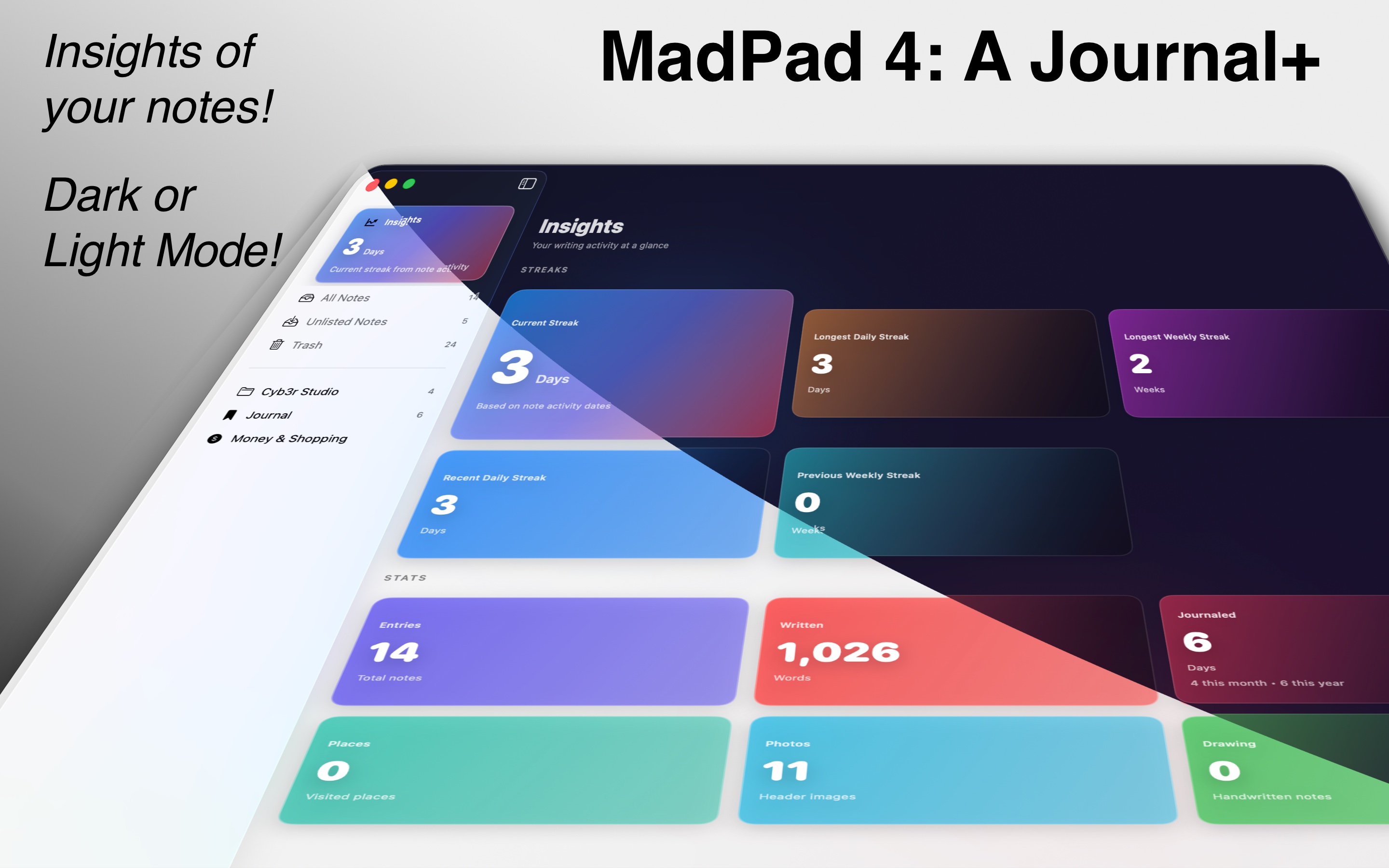
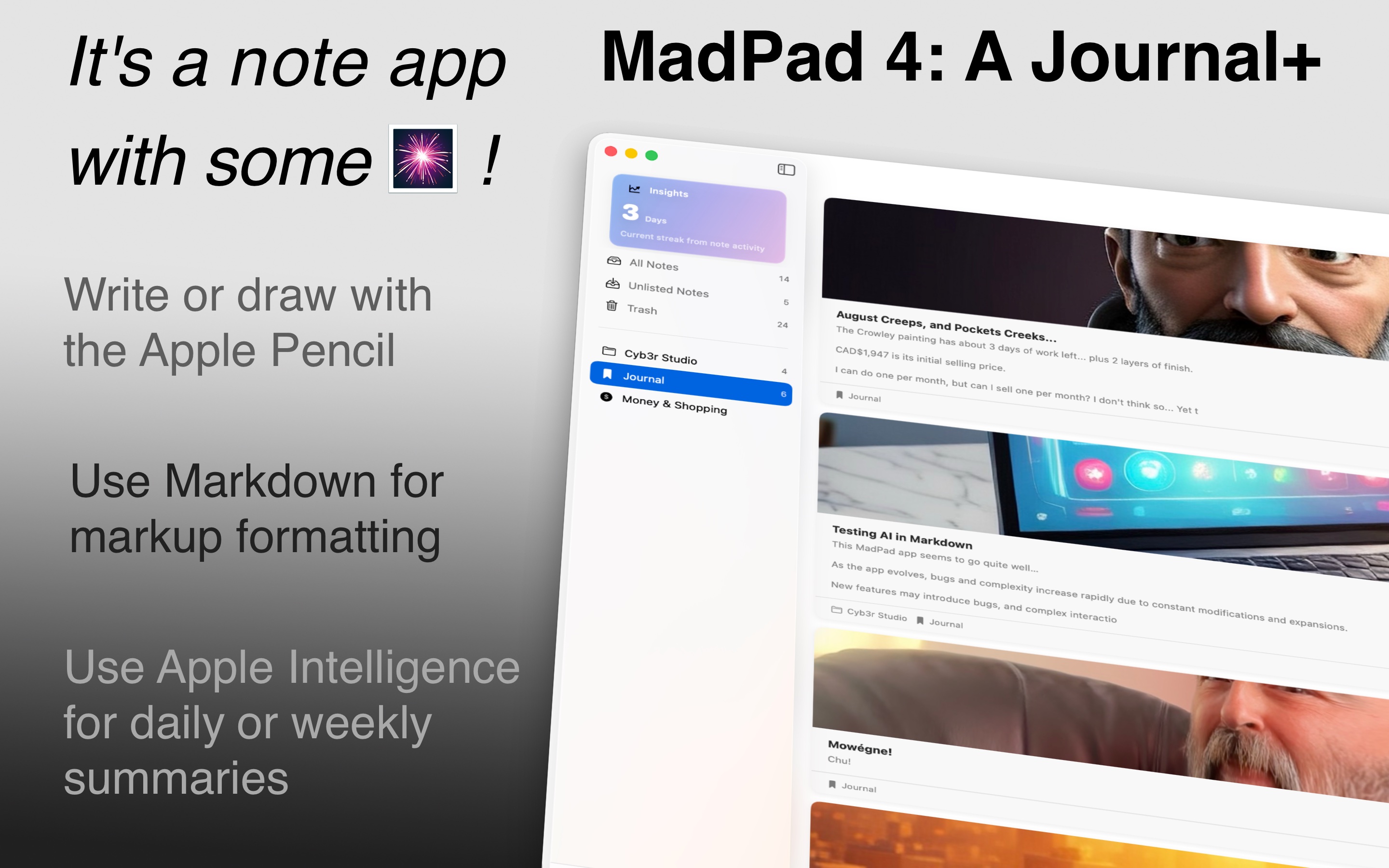
<p>The result of our smallish efforts is MadPad, a macOS and iOS app that allows users to create and manage their notes in a simple and intuitive way. The app was built using a combination of AI-generated code and very minor manual coding, demonstrating the potential of AI assistants in app development. We were able to focus on the prompting and engineering depth of functional aspects of the app, such as its design and user experience, while the AI handled much of the coding and debugging work.</p>

<p><img src="/assets/images/posts/2026/06/madpad-app-screenshot1.jpg" alt="MadPad App Screenshot" />
MadPad’s user interface, designed with the help of AI assistants.</p>

<p>MadPad is a combination of some ideas along the Apple Journal diary app. We felt it missed something and we needed some extras to it, because we liked how it was presented but didn’t want to use it by lack of some features, such as Markdown support. So I built it myself, I mean we built it with the help of AI assistants, and it turned out to be a great learning experience. I was able to see firsthand how AI can assist in the development process, making it more accessible for those who may not have a background in programming.</p>

<p>Now this wasn’t my first ai assisted project, but it was the first time I built a fully functional app with the help of AI assistants on a new platform-platform which I revisited 10 years after my first introduction to Apple devices. As always using AI assistants, I develop along PRDs (Product Requirement Documents), focus on modular design, and tweak components and UI features as I go, and the AI assistants help me with all of that, from generating code to suggesting design improvements. It was a great opportunity to learn and experiment with new technologies, and it showed me that being semi-illetterate in programming doesn’t have to be a barrier to creating functional and useful applications. With the right tools and resources, anyone can bring their ideas to life, regardless of their coding background.</p>

<p>Some are going to say “Hey, but you copied the Apple Journal app, you just added some features to it, you didn’t build it from scratch!”. And that’s true, I didn’t build it from scratch, in UI and UX means, but I built it from scratch in code, and I built it with the help of AI assistants, which is a new way of building apps. It’s not about reinventing the wheel, it’s about using the tools available to you to create something that fully meets your needs.</p>

<p>And by meeting my needs, I mean any feature that I wanted to add to the app, I added it, and I didn’t have to worry about the technical details of how to implement it. The AI assistants took care of that for me, allowing me to focus on the UI/UX and the overall user experience-functionally and design-wise. No Swift or SwiftUI coding knowledge was required, just the ability to prompt and guide the AI assistants in the right direction… but of course, some software engineering knowledge is better than none.</p>

<p><img src="/assets/images/posts/2026/06/madpad-app-screenshot2.jpg" alt="MadPad App Screenshot" />
MadPad’s note management features, implemented with the help of AI assistants.</p>

<h1 id="faultive-and-effective-llms">Faultive and Effective LLMs</h1>

<p>While AI assistants have made it easier for semi-illetterate, but still software engineers, to build apps, it’s important to acknowledge that they are not perfect. AI-generated code can sometimes be faulty or inefficient, and it may require manual intervention to fix issues, or some tweaks, but that’s part of the learning process-and LLMs will evolve! It’s important to approach AI-assisted development with a critical eye and be prepared to troubleshoot and refine the code as needed. But yet, they are better and better at generating code, and they are getting better at understanding the context and requirements of the app, which is a great thing for semi-illetterate developers and engineers.</p>

<p>Does this mean future developers will be more focused on the design and user experience aspects of app development, while relying on AI assistants to handle the coding and technical details? It’s possible, but it’s also important to remember that having a solid understanding of programming concepts and software engineering principles is still extremely valuable, even in an AI-assisted development environment. The ability to guide the AI assistants effectively and make informed decisions about the design and functionality of the app is crucial for creating a successful application. So while AI assistants can help with the coding aspect, it’s still important for developers to have a strong foundation in programming and software engineering to ensure that they can create high-quality applications that meet their users’ or own needs.</p>

<p>Now, speaking of client’s or own needs, I built this app for myself, and I built it in a way that it fully meets my needs, and I can say that it does. It has all the features I wanted, and it works well on both macOS and iOS. It’s a great example of how AI assistants can help semi-illetterate developers create functional and useful applications that meet their specific needs. At that is central to my understanding that the future of app development is going to be more personalized and self-centric, where individuals can create applications that are tailored to their own needs and preferences, rather than relying on generic solutions that may not fully meet their requirements or desires-thus making them acquire more apps to fulfill the gaps. This shift towards personalized app development is an exciting prospect, as it allows for greater creativity and innovation in the types of applications being created. With AI assistants, individuals can bring their unique ideas to life and create applications that are truly their own, without needing to be expert programmers. This democratization of app development has the potential to lead to a more diverse and vibrant app ecosystem, where a wider range of voices and perspectives are represented in the applications being developed.</p>

<h2 id="american-llms-vs-chinese-llms">American LLMs vs Chinese LLMs</h2>

<p>I used several LLMs to build the app, and I found that American LLMs were more effective in generating code and understanding the requirements of the app, while Chinese LLMs were more lacking confidence in their code generation capabilities, even with reasoning. This may be due to differences in training data and language models, but it’s an interesting observation that highlights the importance of choosing the right LLM for your development needs.</p>

<p>While some Chinese LLMs may still struggle with code generation, they can still be useful for other aspects of app development, such as scaffolding, design suggestions, and user experience improvements. It’s important to leverage the strengths of each AI assistant and use them in a complementary way to achieve the best results. Yet, the gap between American and Chinese LLMs in terms of code generation is narrowing, and we can expect to see improvements in both over time. We can kind of smell American LLMs distillation in Chinese LLMs, and that’s a interesting but insufficient thing for the development community as a whole. They ain’t there yet.</p>

<p>American LLMs such as Anthropic’s <code class="language-plaintext highlighter-rouge">Claude Sonnet 4.6</code> was mostly used for code generation, and Github’s <code class="language-plaintext highlighter-rouge">GPT-5.3-codex</code> was used for debugging and code refinement. On the other hand, Chinese LLMs such as the different <code class="language-plaintext highlighter-rouge">Qwen 3 Coder</code>s were used for scaffolding and design suggestions, but they were less effective in generating code and understanding the requirements of the app. One of them in particular, <code class="language-plaintext highlighter-rouge">Qwen3 Coder Plus</code>, was very bad at generating code, constantly calling invalid tools and making the bill go up in tokens without generating any useful code. It could have been an inference issue, but it was a frustrating experience that highlighted the limitations of some Chinese LLMs in code generation, expecially those from obscure providers. We were using OpenRouter.ai’s API to access these LLMs, and it was interesting to see the differences in performance between the American and Chinese models. It’s clear that there is still work to be done in improving the capabilities of Chinese LLMs for code generation, but we can expect to see advancements in this area in the near future.</p>

<h1 id="conclusion">Conclusion</h1>

<p>We have our home made journaling app, MadPad, built with the help of AI assistants and without any prior Swift or SwiftUI knowledge. This experience has shown us that being semi-illetterate in programming doesn’t have to be a barrier to creating functional and useful applications. With the right tools and resources, anyone can bring their ideas to life, regardless of their coding background. AI assistants have opened up new possibilities for app development, making it more accessible and inclusive for a wider range of people. As AI technology continues to evolve, we can expect to see even more innovative applications being built by individuals who may not have traditional programming skills, or programming language knowledge, but who have the creativity and vision to use AI as a powerful tool in their development journey. So, if you have an idea for an app but feel intimidated by the coding aspect, don’t let that stop you. Embrace the semi-illetteracy and leverage AI assistants to turn your vision into reality. Especially if you have some software engineering knowledge, you can guide the AI assistants in the right direction and create something truly amazing. The future of app development is here, and it’s more inclusive than ever before.</p>]]></content><author><name></name></author><category term="opinion" /><category term="technology" /><category term="software development" /><category term="semi-illetterate" /><category term="app development" /><category term="ai assistants" /><category term="programming" /><category term="coding" /><category term="software development" /><summary type="html"><![CDATA[I Don’t Know Swift or SwiftUI…]]></summary><media:thumbnail xmlns:media="http://search.yahoo.com/mrss/" url="https://vyb3r.ca/assets/images/posts/2026/06/how-to-be-semi-illetterate-and-build-a-fully-functional-app.png" /><media:content medium="image" url="https://vyb3r.ca/assets/images/posts/2026/06/how-to-be-semi-illetterate-and-build-a-fully-functional-app.png" xmlns:media="http://search.yahoo.com/mrss/" /></entry><entry><title type="html">New Domain, New UI, New Focus</title><link href="https://vyb3r.ca/announcement/2026/06/14/new-domain-new-ui-new-focus.html" rel="alternate" type="text/html" title="New Domain, New UI, New Focus" /><published>2026-06-14T18:00:00+00:00</published><updated>2026-06-14T18:00:00+00:00</updated><id>https://vyb3r.ca/announcement/2026/06/14/new-domain-new-ui-new-focus</id><content type="html" xml:base="https://vyb3r.ca/announcement/2026/06/14/new-domain-new-ui-new-focus.html"><![CDATA[<h1 id="welcome-to-the-new-vyb3rca">Welcome to the New Vyb3r.ca!</h1>

<p>I’m excited to announce that I’ve launched a new website at <a href="https://vyb3r.ca">vyb3r.ca</a>! This new domain reflects my personal brand and allows me to share my work, thoughts, and projects in a more cohesive way.</p>

<p>The new website features a fresh, modern design with improved navigation and a focus on my latest projects and insights. I’ve also added a blog section where I’ll be sharing regular updates, tutorials, and industry news.</p>

<p>In addition to the new domain and design, I’m also shifting my focus towards AI &amp; ML, Apple technologies and mobile development. I’m passionate about this field and look forward to sharing my knowledge and experiences with you all. Whether you’re a fellow developer, a tech enthusiast, or just curious about what I’m up to, I invite you to explore the new site and stay tuned for exciting content coming your way!</p>

<p>Thank you for your continued support, and I can’t wait to connect with you all on <a href="https://vyb3r.ca">vyb3r.ca</a> aka <a href="https://cyb3r.studio">cyb3r.studio</a>!</p>]]></content><author><name></name></author><category term="announcement" /><category term="news" /><category term="updates" /><summary type="html"><![CDATA[Welcome to the New Vyb3r.ca!]]></summary><media:thumbnail xmlns:media="http://search.yahoo.com/mrss/" url="https://vyb3r.ca/assets/images/bg01.jpg" /><media:content medium="image" url="https://vyb3r.ca/assets/images/bg01.jpg" xmlns:media="http://search.yahoo.com/mrss/" /></entry></feed>